Mind Map
Branch ideas from a central topic to explore connections and discover patterns.
Design and innovation teams
The toolkit’s 44 thinking tools, grouped under the stages of the Double Diamond: Discover, Define, Develop and Deliver. All free, no login, nothing to install.

Branch ideas from a central topic to explore connections and discover patterns.
Write what you think you know about your user, plan how to find out, then mark each guess right or wrong.
Plan open questions for a real person, then record what they said and what surprised you.
Watch someone do the task: note what they do, how they do it, then guess why.
Try your user's task with one thing changed, and log what was hard, how it felt and how you got round it.
Map what users say, think, do, and feel to build deep understanding.
Trace a user's experience step by step to find pain points and opportunities.
Identify who your design affects and what they need from it.
Create a fictional user profile based on real research data.
Define who you're designing for — demographics, needs, and context.
Look to nature for design inspiration and sustainable solutions.

Group and organize ideas into natural clusters to find themes.
Dig to the root cause of a problem by asking "why?" five times.
Map all possible causes of a problem in a structured visual.
Evaluate Strengths, Weaknesses, Opportunities, and Threats.
Connect concepts with labeled relationships to show understanding.
Visualize how parts of a system interact and influence each other.
Set clear success criteria your design must meet.
Map user needs as "As a... I want... So that..." stories.
Distill your research into a clear problem statement.
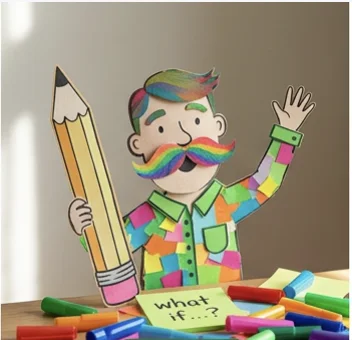
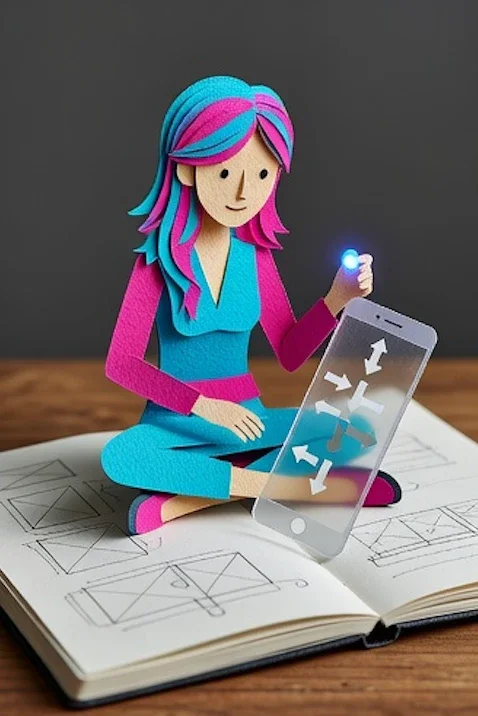
IdeateLots of ideas first. Pick one after.8 tools
7 thinking strategies to transform existing ideas into new ones.
Expand a central idea into 8 themes, then 8 sub-ideas each.
Brainstorm bad ideas first, then flip them into real solutions.
Combine features across categories to generate novel combinations.
Free-form idea generation with visual web connections.
Break big ideas into smaller branches of sub-ideas.
Silent brainstorming: write, pass, build on others' ideas.
Look at a problem from 6 different thinking perspectives.
PrototypeMake it real, roughly, then properly.7 tools
Map how your design creates value for users.
Plan a focused 5-day design sprint process.
Collect visual inspiration to guide your design direction.
Sketch a sequence showing how users interact with your design.
Document detailed technical requirements for your design.
Track changes and improvements across design iterations.
Rapid sketching with timer to explore ideas visually.


TestTry it. Find what breaks. Fix it.9 tools
Evaluate ideas by listing Plus, Minus, and Interesting points.
Score options against weighted criteria to make informed choices.
Democratic prioritization: everyone gets limited votes.
Compare options head-to-head in pairs to find the best.
Organize feedback into likes, wishes, questions, and ideas.
Plot ideas on a 2×2 grid of impact vs effort to prioritize.
Build rubrics for self, peer, or teacher assessment.
Structured peer feedback with sentence starters.
Reflect on your portfolio with structured self-evaluation.
ShareShow what changed, and why.2 tools
Sketch a sequence showing how users interact with your design.
Reflect on your portfolio with structured self-evaluation.
Double Diamond beside five other frameworks, stage by stage. Compare them →
The stage names are the framework’s own (Design Council, UK); which tools sit under each is our reading. The Double Diamond, Design Council ↗
The Double Diamond by the Design Council is licensed under a CC BY 4.0 license.
Inside StudioLoom these tools sit in your lessons and every student’s work is kept. Get started →